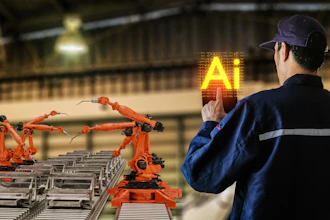
Manufacturers increasingly need to monitor agents and ensure security is in place while AI adds value to the organization. At IMTS 2026 in Chicago, Keith Dunnell, VP and global head of manufacturing industry at ServiceNow, said AI agents are always accessing data, but now they’re also making decisions. So, it's critical to have a constant view of what agents are doing: what data they're accessing, what decisions they're making and what risks may be surfacing from agents. Monitoring is critical to make sure threats are not coming into the organization.
Manufacturers can use AI agents in several ways. The focus is on improving customer outcomes. Originally, AI deployments were focused on automating manual tasks and making work faster. Now manufacturers can think about how to use AI to protect customer outcomes. Consider, for example, when a plant needs to take a machine down for maintenance. Before AI, the machine would go down, and no one would consider which customer orders might be impacted by late shipments. AI can proactively identify when a plant machine needs to go down, determine which customer orders may be impacted, and notify the plant manager and sales manager at the same time.
Dunnell said this allows a manufacturer to proactively contact a customer and change the ship date or send an alternative product that is in stock.
AI in Root Cause Analysis
When a manufacturer is trying to determine a root cause after an incident, Dunnell said AI can gather data very quickly and perform preliminary analysis on the potential root cause, helping manufacturers fix defects faster.
AI in Manufacturing Human Resources
Another use case for AI that ServiceNow is seeing in the market focuses on human resources and answering common worker questions, such as benefit summaries or other questions about compensation. By answering these questions quickly, AI helps workers get back to work faster.
AI Adoption: 'Show It to Me and Prove It to Me'
Manufacturers are skeptical about technology and want to make sure AI isn't a risk to their operation. Adoption has been: "Show it to me and prove it to me first," Dunnell said. The tech migration started with manufacturers doing proof-of-concept projects, which evolved to pilots, and now manufacturers are looking to scale AI.
"As we see manufacturers move to scaling from just doing pilots, in one to five years, we should see a lot more automation both on the plant floor, not only from an IoT and robotics perspective, but also the connection between the technology that runs their machines and the technology that runs the business," Dunnell said. "We call this the IT to OT bridge. AI can connect both of those, so now enterprise decisions can be made that both affect the front office as well as the factory floor and optimize customer experience all together."
Concerns Over Cybersecurity
Manufacturers are facing an uptick in cyberattacks. The attacks are not only physical but targeted at operating technology used to run machines. Dunnell said AI represents a new line of defense.
"We have a concept called a ‘kill switch’ where we can monitor AI agents, or our customers can monitor AI agents in terms of what they're doing at all times, and if a risk is detected, they can actually isolate the AI agent and shut it off from the data that it's accessing to make sure that the risk does not pervade the enterprise.”