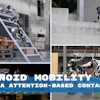
The Robotic Systems Lab of Legged Robotics at ETH Zürich recently presented a contact-centric learning framework for versatile humanoid mobility in complex and unstructured environments.
Their approach bridges motion imitation and reinforcement learning by leveraging human motion data as a training prior while enabling autonomous adaptation to previously unseen terrains.
The framework consists of three main stages:
- A unified controller pretrained using contact information extracted from reference motions, learning coordinated whole-body behaviors without requiring full-body reference trajectories as policy inputs.
- A self-supervised contact that planner predicts future body–environment contact locations for nine body parts, conditioned on terrain observations, robot proprioception and goal commands.
- The planner and controller are further optimized on diverse terrains beyond the original motion dataset, enabling improved generalization and autonomous skill transitions.
The team said it validated its framework through real-world experiments on the Unitree G1 humanoid robot, demonstrating a range of whole-body locomotion capabilities, including ladder climbing, vaulting, crawling, stair climbing, sparse foothold traversal and autonomous failure recovery.
All behaviors are executed using a single generalist policy with onboard sensing, without reference motions or explicit skill-switching mechanisms at deployment, according to the researchers.