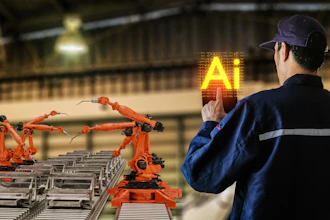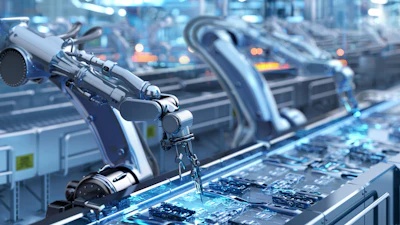
For years, predictive maintenance has been one of industrial AI's biggest success stories. It has given manufacturers greater visibility into machine health, reduced unplanned downtime, and improved maintenance planning. Yet, prediction was never the end goal.
Industrial AI is entering a new and significant phase. Instead of simply forecasting when equipment might fail, today's systems can increasingly determine why failures occur and respond before they disrupt operations. In some environments, corrective action can begin before an operator even realizes a problem exists.
That represents a fundamental shift in how AI supports manufacturing. The focus is shifting from anomaly detection to root-cause analysis and automated response. While ideas like self-diagnosing or self-healing machines may sound futuristic, many of the capabilities behind them are already being deployed.
Modern industrial systems can do more than identify faults. They can also isolate the source of a malfunction and automatically initiate a corrective response, whether that means adjusting operating parameters, redistributing workloads across connected equipment, or performing targeted calibration to maintain production. The difference lies in how these systems interpret data.
Today's AI models combine synchronized inputs such as vibration, temperature, acoustic signals, control logs, and visual data, then interpret them within the context of how a machine is operating at that moment. Rather than matching current conditions to historical patterns alone, they can identify why a problem is developing. That moves industrial AI beyond recognizing anomalies toward understanding them.
Why This Shift Is Happening Now
Two advances have made this evolution possible.
The first is the move towards edge computing. Instead of sending operational data to centralized systems for analysis, AI models now run alongside the equipment they support. Processing data locally eliminates latency and enables real-time decisions where even small delays can have operational consequences.
The second is multi-modal AI. Instead of relying on separate models for machine vision, telemetry, and control logic, manufacturers can now analyze those inputs together, which gives AI a unified understanding of both a machine's physical condition and its intended operation.
As a result, AI is becoming an active participant in the environments it monitors. Most manufacturers are familiar with predictive maintenance: identifying when equipment is likely to fail. The next stage is a closed-loop process that handles the entire lifecycle of a fault:
- Detects subtle operational deviations
- Diagnoses the underlying cause
- Determines the appropriate corrective action
- Executes that response in real time
Instead of simply alerting operators to an approaching failure, these systems can adjust operating conditions to prevent it, maintain product quality, and defer maintenance until the least disruptive opportunity. AI is moving from supporting decisions to executing them within clearly defined limits.
Autonomy, with Guardrails
Industrial AI has not reached unrestricted autonomy, nor should it. “Supervised autonomy” better describes today's deployments: systems operate independently within limits set by engineers. High-consequence actions, like replacing physical components or making structural changes, still require human oversight.
Those safeguards are essential in manufacturing where mistakes can be costly or dangerous. Hardware interlocks, operating thresholds, and confidence scoring ensure control returns to a human operator when uncertainty exceeds acceptable limits, rather than letting the system act on incomplete information.
The Technical Foundation: Context Over Data Volume
At the core of this shift is a challenge that is often underestimated: context
Industrial environments generate enormous volumes of telemetry, so individual signals alone are not enough. A temperature spike or increase in vibration means little without knowing what the machine was doing when it occurred.
Modern AI addresses this by embedding operational context directly into its models. Instead of relying on fixed thresholds, it builds behavioral baselines that account for workload, environmental conditions, and production state. That allows it to distinguish normal variation from emerging faults.
Another challenge is the limited availability of real-world failure data. Serious equipment failures occur infrequently, which makes them difficult to capture in sufficient quantities for training. To overcome this, developers increasingly use self-supervised learning alongside synthetic datasets generated through simulation and digital twins. This enables models to recognize failure modes they have never encountered during live operation.
Where It's Delivering Value Today
The benefits are already evident in industries where uptime and precision directly affect profitability: automated assembly, semiconductor manufacturing, high-speed packaging, and continuous process operations. By detecting problems early and addressing them in real time, AI can reduce scrap, help prevent equipment damage and keep production consistent.
However, while the technology is advancing quickly, deploying these capabilities remains challenging. The AI model is often the easier part. Integrating data from legacy and modern equipment, often produced in different formats with limited interoperability, requires translation, normalization, and orchestration at the edge. Preserving operational context throughout that process is equally important. Without it, even sophisticated models struggle to produce reliable and actionable results.
The Next Wave: Collaborative Intelligence
The next stage of industrial AI will not be defined by increasingly capable standalone models, but by how multiple AI systems work together.
Manufacturing is moving toward agent-based environments where AI systems exchange context and coordinate decisions while collaborating across the factory floor. They will also interact more naturally with human operators, like explaining their actions, requesting guidance when necessary, and working toward shared production goals.
Early examples are already appearing in autonomous production cells and highly automated warehouses. Fully autonomous factories remain further in the future, with advances in coordination, safety, and interoperability still needed before end-to-end autonomy becomes practical.