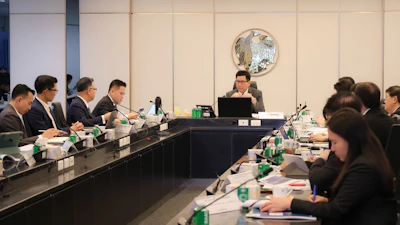
Thailand approved its first national strategy for the semiconductor and advanced electronics industry, aiming to create an integrated domestic ecosystem that spans chip research and design, front-end manufacturing, conventional and advanced assembly, packaging and testing and high-value electronics applications.
READ MORE: What U.S. Manufacturers Can Learn from Thailand’s Factory Pipeline
The strategy targets three multiple technology platforms:
Photonics for artificial intelligence, data centers and high-speed communications
Power semiconductors for electric vehicles, energy-storage systems and power grids
Sensors
Approved by the National Semiconductor and Advanced Electronics Policy Board, chaired by Deputy Prime Minister and Finance Minister Ekniti Nitithanprapas, the strategy targets about $80 billion in cumulative investment and approximately $150 billion in annual industry revenue by 2050. It also looks to create more than 230,000 new jobs under Thailand’s long-term “Made in Thailand” chip initiative.
“This is Thailand’s first comprehensive national framework for building semiconductor capabilities and moving the country into higher-value activities across the global supply chain,” Nitithanprapas said. “It gives investors a clear view of our technology priorities, infrastructure commitments and workforce-development plan through 2050.”
Thailand will implement the roadmap in three phases. By 2030, the country expects to reinforce its established assembly and testing base, scale advanced packaging capabilities and lay the foundations for front-end wafer production. By 2040, it will seek more anchor investors in upstream activities, including chip design, wafer fabrication and advanced-technology manufacturing, to fill gaps in the supply chain. By 2050, Thailand aims to have a complete domestic supply chain.
Implementation support will include:
Tax incentives, grants and low-interest financing
Workforce development with industry and academic partners
Upgraded research and chip-design infrastructure and partnerships between foreign and Thai companies
Investment-ready infrastructure, including cluster sites, reliable water and electricity, clean energy and disaster-resilience systems
Regulatory reform and business facilitation for foreign investors and Thai suppliers including a broader market access through FTAs
The board also approved a workforce program under the national strategy coordinated by the Ministry of Higher Education, Science, Research and Innovation with universities, research institutes, industry and international partners. By 2030, the program aims to develop 86,600 workers, including 84,900 highly skilled personnel and approximately 1,700 advanced researchers, through specialized curricula, industry placements, overseas training and programs for faculty members, researchers and technical instructors.
From 2023 through the first half of 2026, the Thailand Board of Investment reportedly received investment-promotion applications for 879 semiconductor and advanced electronics projects worth about $27.2 billion. The projects span chip production at various stages, printed circuit boards (PCBs), hard disk drives, AI servers, networking and power-management equipment and electronic parts for vehicles and office equipment.
Additionally, German semiconductor manufacturer Infineon Technologies plans to open its first Thai factory in Samut Prakan in October. The facility will produce and package advanced power modules for electric vehicles, energy storage, clean energy and advanced electronics. Infineon also plans to establish an R&D center, develop joint curricula with Thai educational institutions and employ more than 5,000 people in Thailand at full operation.
Other developments in Thailand include the United States' Analog Devices for analog and mixed-signal chips, Taiwan's Foxsemicon Integrated Technology for semiconductor-equipment supply and Zhen Ding Technology for printed circuit boards, Singapore's Terahop for optical communications and Malaysian Pacific Industries (MPI) for semiconductor assembly, packaging and testing.