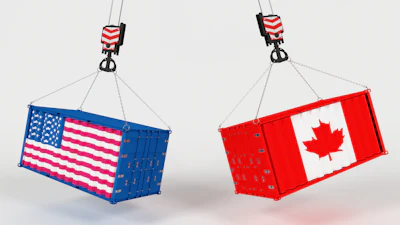
While President Trump's ongoing tariff battles have impacted a diverse collection of countries and markets, perhaps none have felt the brunt of these actions more than Canada. Negotiations are ongoing, and U.S. tariffs will face stronger opposition due to recent shifts in political momentum, but the reality is that our neighbor to the north is still facing 50 percent tariffs on goods worth an estimated $20 billion.
Canada has also issued retaliatory sanctions on a wide range of products, including food and raw materials, that have impacted numerous U.S. manufacturers, especially in the automotive sector. I recently sat down with Jeff Krajacic, Managing Director in the Industrials Practice of SSA & Co., a global management consulting firm, to discuss the long and short-term impacts of this on-going trade war.
Jeff Reinke, editorial director: Who is currently winning this trade battle in North America?
Jeff Krajacic, Managing Director, SSA & Co.: Nobody is winning across the board. Where there are gains, they’re narrow and limited to certain sectors.
Producers that are shielded from imports are able to pick up pricing power or market share. There’s a recent survey that showed that 49.7 percent of manufacturers expected U.S. tariffs to hurt their business over the next 12 months. But earlier this year, 23.2 percent also reported increased sales of Canadian-made products, so the tariffs are helping some companies even while they hurt many others.
The real problem is that North American manufacturing runs on shared supply chains. So, a part can cross the border several times before it ends up in a finished product. Protect one producer and you can end up raising costs for the manufacturer downstream that buys its steel, aluminum, components, or equipment.
Some companies will adjust to these tariffs just fine, but I don’t see how North American manufacturing as a whole comes out ahead.
JR: Who is losing the most right now?
JK: Canadian manufacturing seems to be taking more of the hit, especially in industries that depend heavily on the U.S. market. Payroll employment in Canadian manufacturing fell by ~40,600 jobs from December 2024-December 2025.
The transportation equipment, fabricated metals and machinery industries were hit especially hard. But U.S. manufacturers that rely on Canadian materials and parts are paying more, and U.S. exporters now have to deal with retaliation.
Canada’s September countermeasures cover about C$27.6 billion of U.S. goods, including steel, agricultural equipment, appliances, pulp and paper, plastics and electronics. If the tariff volatility continues, those in the worst position will be North American manufactures that have to lock in sourcing and capital plans years in advance.
JR: What is the ideal outcome for each player?
JK: For the U.S., it’s getting its concerns about market access, rules of origin and non-North American content addressed without damaging the manufacturing base it shares with Canada and Mexico.
For Canada, it’s getting back reliable access to its biggest export market while depending on it less over time. Exporters seem to already be working on that. 72 percent of Canadian exporters plan to enter new markets within two years.
Manufacturers on both sides of the border mostly just want to know where the rules will land and that they won’t just change on a whim. It’s pretty hard to make a sound capital decision when tariff rates, rules of origin, and product coverage can change before money is even spent.
Every unresolved variable gets added to the hurdle rate and the ROIC target, on top of whatever it does to the landed cost.
JR: What is the worst-case scenario?
JK: For Canada, the biggest risk is that a temporary trade disruption turns into a lasting manufacturing problem. If companies start putting new capacity somewhere else because they can’t count on access to the U.S., those decisions are hard to undo.
For the U.S., the risk is that it protects a few upstream industries while raising costs for the much larger number of manufactures that buy from them.
For both, the worst-case scenario is a cycle of tariffs, bans, and counter-tariffs that keeps escalating until companies have to fully rebuild supply chains that took decades to get right. We could end up saving a few industries while making the whole North American industrial base more expensive and less able to compete globally.
JR: What should we watch over the next six months?
JK: First, the USMCA negotiations. The July 1 joint review ended without the U.S. agreeing to renew USMCA as it stands. The agreement stays in force while talks go on, so whatever happens next matters to anyone with cross-border supply. (United States Trade Representative)
Then there are changes to rules of origin, particularly autos, steel and aluminum. Changes here affect where companies put plants and where they buy parts, and those decisions stick around a lot longer than trade flows do. Rules of origin and North American content are already on the table in the review. (United States Trade Representative)
Finally, we need to see what manufacturers actually do. Plant investments, capacity moves and permanent sourcing changes will tell us more than anything coming out of Washington or Ottawa. Once a company moves a plant or a supply base, a trade deal doesn’t move it back. I’d add visibility to the list. Manufacturers that can see their tariff exposure by SKU, supplier and bill of materials can react much faster than the ones who only find out when it shows up in their margins.
If I had to pick one thing to stress, it’s that the uncertainty itself costs money now. Companies deal with it by carrying more inventory, qualifying backup suppliers, holding off on capital spending and building in contingencies. All of that ties up cash, adds overhead or slows things down.