An engineering drawing for an industrial component rarely stops at dimensions. It usually carries functional requirements too: a sealing surface that must hold pressure without leaking, a structural mount that must carry repeated loads without fatigue, a bore that must resist corrosion in a wet or chemical environment. Meeting the dimensions on the drawing is only part of the job. Meeting the function behind it is what shops offering Wayken CNC machining are actually being asked to deliver.
Designing Components for Manufacturing Success
Industrial parts have high demands because manufacturing tolerances generally include all specifications. Hydraulic or pneumatic housings require a machined sealing groove to meet specific surface-roughness requirements. This is because if the surface is too rough, fluid will pass through. If the surface is too smooth, it lacks the texture needed to keep the seal lubricated. Structural brackets also require sufficient wall thickness and fillet radii to withstand cyclic loading and avoid cracking at stress risers.
Although these nominal dimensions may appear equivalent to those used for light-duty parts, heavier-duty parts may experience different loads. In addition, when selecting materials, there is always an emphasis placed upon corrosion resistance and/or wear life. As such, material hardness and sensitivity to temperature changes are also considerations. Therefore, the engineering team must evaluate each component for manufacturability before scheduling a production run, so features that meet dimensional standards but do not perform their intended function (e.g., leakage or cracking) can be identified early in the process.
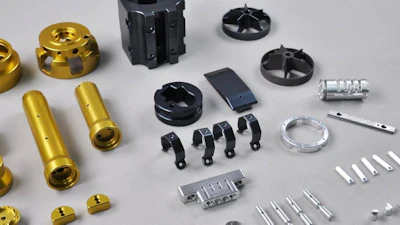
Additionally, CNC machined parts with complex geometries, such as internal cavities, compound angles, and undercut sealing grooves, should undergo this evaluation. Issues related to access during manufacture generally arise after the part is in use, rather than from a rejected dimension on the shop floor.
From Machining Strategy to Finished Component
The quality of the Functional Specification (FS) will define how to create the machining strategy. For example, for automation parts made from aluminum with multiple surface features, deep cavities, compound angles, etc., an average standard vise does not provide enough rigidity to hold the part fixed throughout all operations without deflection from cutting forces.
 WayKen Rapid Manufacturing
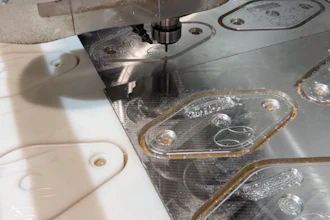
So, instead of using standard work-holding methods, WayKen’s engineers design custom work-holding fixtures based on the component’s geometric requirements. Using this approach, along with 5-Axis machining, allows most complex geometrical features to be machined in a single setup. This is because the ability to maintain the same datum reference for a structural or sealing feature determines whether the finished component meets the FS specifications, not simply the dimensions called out.
Also, sealing surfaces and load-bearing features are major drivers of cutting parameters, not just the type of tools used. The quality of finish achieved on a sealing groove may require slower, lower-engagement cuts than the fastest way to remove material. Since finish quality and material removal rates are typically inversely proportional, achieving both high-quality finishes and efficient material removal rates is very difficult.
Inspecting the seal groove and load-bearing features during production provides several advantages over checking them after completion. If a problem develops in either finish or tolerance during production, it can be addressed by making a re-cut. However, if a problem develops with finish or tolerance at completion, it results in scrapping the entire component.
 WayKen Rapid Manufacturing
Consistency Matters as Much as Precision
An industrial buyer isn't qualifying a part once. A component that seals correctly on the first unit but leaks on the fiftieth hasn't met its spec; it's failed intermittently, which is harder to catch and more costly downstream. Fixture wear, tool degradation, and stock variation can all shift a sealing or load-bearing feature outside its functional range while staying within printed tolerance.
Outgoing quality control before shipment verifies dimensional accuracy, geometric conformity, and surface finish, with inspection reports and material certifications documenting that each unit in a batch was built to the same standard, not just the first one measured. WayKen applies this alongside its upfront DFM review, treating functional performance as something verified across the run rather than assumed once demonstrated on a prototype. That structure is what lets an engineering team order a repeat batch through Wayken CNC machining and trust that unit one hundred performs the same as unit one.
Conclusion
A demanding industrial spec is rarely just a tight tolerance. It's a functional requirement- sealing, load capacity, corrosion resistance- that the machining plan has to protect through fixture design, cutting strategy, and inspection, not just an accurate CAD file. Manufacturers that plan around the function, not only the dimension, are the ones whose parts still meet spec after the hundredth unit.