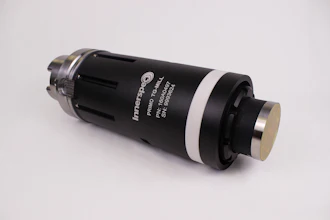
Tark Thermal Solutions (Germany) today announced the PowerCycling PCX-DG Series, a new family of thermoelectric coolers engineered for higher current draw and high heat flux density applications like end-of-line (EOL) optical transceiver test heads, semiconductor test sockets and other systems exposed to frequent, rapid temperature reversals.
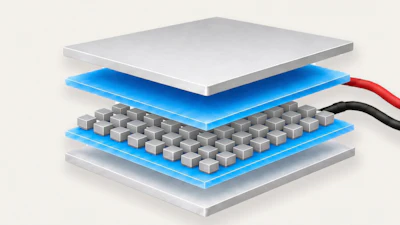
The PCX-DG Series provides compliant, thermally conductive bonding layers at both ceramic-side interfaces of the thermoelectric module. The dual-interface construction is designed to absorb more of the differential expansion and contraction generated during power cycling, reducing the mechanical stress transferred through the cooler as it repeatedly moves between heating and cooling operation.
Features include:
- Validated in semiconductor test applications to withstand more than 200,000 power cycles without performance degradation, regardless of form factor.
- Flexible, thermally conductive bonding layers on both ceramic sides reduce stress from coefficient-of-thermal-expansion mismatch during repeated heating and cooling cycles.
- Rated for a maximum operating temperature of 120°C, supporting applications that operate across a broad temperature window.
- The broader PCX family offers solid-state operation and next-generation thermoelectric materials, which TTS developed for applications requiring high-frequency cycling, fast temperature changes and precise control.
- Available in multiple footprints to support different thermal-head, heat-load, socket and packaging requirements—variants specifically for harsh cycling environments and high heat-flux densities.
- Increased mechanical durability that directly protects test yield and equipment uptime.
Test heads used in end-of-line (EOL) testing of pluggable optical transceivers, including QSFP-DD, OSFP and CFP2 modules, subject TECs to some of the harshest duty cycles in the industry. A typical test cycles each module through cold, ambient and hot temperatures to verify laser wavelength stability, bit-error-rate, optical power and extinction ratio, all while the TEC actively removes several watts of continuous heat from a powered module.
Semiconductor burn-in and final test present a comparably demanding environment. As test-socket form factor and cooling capacity (Qc) increase, it becomes harder for a TEC to survive the cycling. In both applications, the rapid, repeated transitions between hot and cold setpoints across wide temperature swings make conventional solder-bonded TECs vulnerable to cracking, delamination, and bowing. The repeated thermal expansion and contraction, often hundreds of thousands of times over a TEC's service life, stresses and fatigues the rigid solder joints between the ceramic substrate and copper interconnects.
For more information, visit https://tark-solutions.com/. The PCX-DG Series provides compliant, thermally conductive bonding layers at both ceramic-side interfaces of the thermoelectric module to absorb more of the differential expansion and contraction generated during power cycling.Tark Thermal Solutions