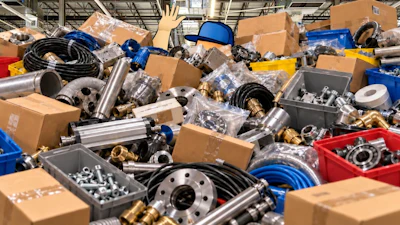
Novak Conversions manufactures Jeep engine and transmission conversion products in Utah. The company has more than 5,000 inventory items covering components, assemblies, and finished products.
As the business grew, spreadsheets and its previous manufacturing software became increasingly difficult to manage. Novak eventually moved its inventory and production processes into MRPeasy.
General Manager Davis Edwards puts the threshold quite practically: “If you work with hundreds or thousands of items, MRPeasy just makes sense.”
Today, the company's entire 5,000-item inventory is connected to bills of materials, production orders, purchasing, lot and serial tracking, and real-time cost data. The company reports fewer backorders and stockouts, while customers receive their orders faster.
BOMs turn thousands of items into manageable product structures
A flat list of 3,000 components is not particularly useful when trying to build a complex machine.
Nexus Automation and Control Systems manufactures custom industrial control equipment and keeps around 3,000 SKUs in stock. Some projects contain BOMs seven levels deep.
Before implementing ERP software, the team tried to manage these structures using Excel. The result was considerable administrative work, missed parts, excess inventory, stockouts, and expedited shipping costs.
Multi-level BOMs now organize components into products and subassemblies and connect those structures directly with purchasing and production.
“Being able to visualize everything, tie documents and drawings directly to parts, and keep all information in one place is a great value,” says President Jason David.
Nexus reports that this has drastically reduced both stockout risk and the costs associated with overstocking. Reusable assemblies also no longer need to be rebuilt from scratch every time a similar project comes in.
Accurate stock data prevents both shortages and excess inventory
Poweronics manufactures power electronics products and manages around 1,200 components.
Before implementing its current system, component shortages were a recurring problem. After moving inventory, manufacturing orders, purchasing, and sales into one system, this changed.
“We’ve never had a material shortage after adopting MRPeasy,” says Colin Hart, Managing Director.
Product variations multiply SKU counts quickly
Trig Point shows how rapidly customization can increase inventory complexity.
The Australian automotive manufacturer produces 4WD canopies and trays and now manages more than 6,000 part numbers across two factories. Product options and variations mean that apparently similar components may need to be treated as separate inventory items.
After implementing MRPeasy, the company brought its part numbers, BOMs, manufacturing orders, purchasing, and product configurations into the same system.
Production Engineer Chris Wasylkiw says: “We wouldn’t be able to manage that without a system like this.”
Complex manufacturers also need revision control
Some manufacturers have a further problem: thousands of parts are changing over time.
Blighter Surveillance Systems manufactures radar systems with BOMs containing up to 60,000 components. The company needed to maintain its own part numbers, manage multi-level BOMs, and keep control over engineering revisions.
For this type of manufacturer, knowing that a component exists is not enough. Production needs to know which revision should be used, purchasing needs the correct requirement, and engineering changes need to reach the rest of the company.
“MRPeasy has helped us hugely with controlling the flow of goods and making sure we haven’t got loads of bits sitting around that we don’t know the use of,” says James Watt, Supply Chain Coordinator.
Thousands of SKUs require a better system, not a bigger spreadsheet
High SKU counts are not exclusive to large manufacturers.
Our case studies include businesses with relatively small teams managing thousands or even tens of thousands of components.
The companies that keep this complexity under control use the same basic principles:
- every item has a clear identity
- BOMs define where components are used
- stock movements are recorded consistently
- purchasing is connected to actual material requirements
- product revisions and variants are controlled
- departments work from the same current data
As SKU counts and production complexity increase, spreadsheets start to break down. This is when most manufacturers realize that free spreadsheets actually cost them more than a dedicated software would. A manufacturing ERP system like MRPeasy can help manufacturers of complex builds efficiently manage their inventory, production, purchasing, sales, and finances – all without breaking the bank.
To learn more, visit www.MRPeasy.com.