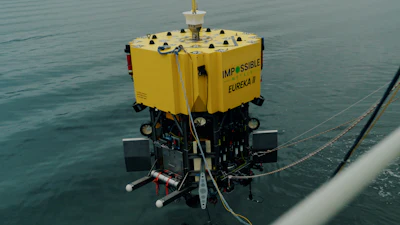
Impossible Metals today announced that its Eureka Collection System has become the first in the world to selectively recover polymetallic nodules from the deep ocean using a fully autonomous underwater robot, completing a scientific dive in the Clarion-Clipperton Zone at a depth of over 4,000 meters (2.5 miles). This zone is in the eastern and central Pacific Ocean, stretching between Hawaii and Mexico.
It is the first time a fully autonomous underwater robot has selectively collected nodules, and done so gently, hovering above the seabed without a riser pipe.
The dive recovered about 450 grams of nodules, which Viridian Biometals will use to study bacterial populations living in the nodules. The dive was conducted as marine scientific research.
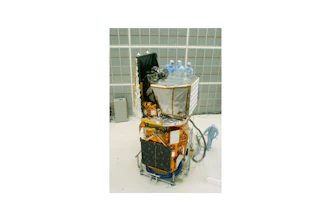
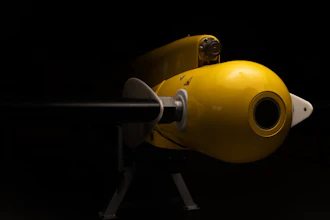
Eureka is a patented technology that hovers above the seabed rather than driving across it. A buoyancy engine allows the vehicle to lift its payload by harnessing the physics of water displacement, removing the need for a riser pipe and the process-water discharge and cost that come with one. As it works, the system’s perception layer identifies visible life on and around each nodule and leaves those nodules where they are, selecting only from the remainder.
 Robotic end effectors are used to pick up only the selected nodules. Impossible Metals
“The purpose of the dive was to sample a few nodules to help advance understanding of bacterial populations in nodules. To see the entire system work in the middle of the Pacific, deeper than the Titanic, which was incredible," said Steve Curnutte, CEO of Impossible Metals. "The questions we set out to answer are answered. Eureka is proven, patented and ready. And because it scales by adding robots one at a time rather than building substantial infrastructure all at once, it has a fundamentally different cost structure from anything built around a riser and a fleet of surface ships. What remains is scaling and manufacturing, not invention.”
Impossible Metals expects to provide a robots-as-a-service solution to the industry. The company is partnering with contractors to supply and operate the Eureka Collection System.
All scientific data collected during the dive will be published openly. Impossible Metals did the same after its Eureka II dives on the Blake Plateau two years ago, publishing the full dataset and linking to it from the company website.
In 2027, the company will put Eureka III, the scaled-up version, in front of an independent scientific team aboard the German research vessel RV SONNE, under an environmental impact study initiated by Germany’s Federal Institute for Geosciences and Natural Resources (BGR). Impossible Metals also works with a standing group of nine independent scientists, convened on terms that let them disagree with the company publicly.
Viridian Biometals is a research partner of Impossible Metals, working on bacterial approaches to recover metals from polymetallic nodules that use less water, less energy, and no acid. This research program drove the dive, and the recovered material is being studied under it.