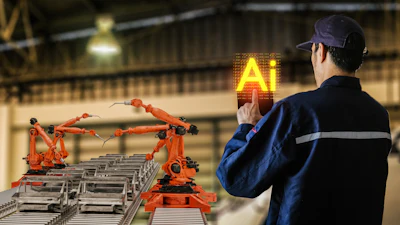
Walk a plant floor almost anywhere in the world and it won’t look much different than it did 20 or 30 years ago. The machinery keeps getting better. IoT has arrived. And we might see some early use of robotics. But the business processes and systems that operate the floor have largely stayed the same.
Day to day, most manufacturing still runs on a series of disconnected decisions. Data gets committed to one system, exported to a spreadsheet, interpreted by the next person or team, and turned into another decision that gets passed back down the line. A lot of it still lives in Excel.
AI is showing up in that picture, but mostly at the edges. A recent Manufacturers Alliance study of more than 100 mid- and large-cap manufacturers found that 32 percent are running active agentic AI pilots and another 39 percent are still identifying possible workflows. Only about six percent have integrated agentic AI into live production.
The problem isn’t access. Manufacturers have more models, use cases, and vendors to choose from than ever. The problem is that most initiatives stop at the insight. AI identifies the defect, predicts the failure, flags the late material, or generates the forecast. Then someone opens Excel, sends an email, waits for a meeting, and tries to coordinate the next step.
The technology is real. We’re just not thinking big enough about what it can do.
Detection is the Start of the Workflow, Not the End
The same handful of AI use cases show up again and again. Some work well enough today: a quality-inspection rig over a line, cameras on forklifts reading barcodes as inventory is picked and put away, a model that spots an equipment anomaly before it becomes a failure.
Others, like digital twins and predictive maintenance, are aspirationally correct but harder to roll out because of the cost and complexity of connecting IoT, operational data, and legacy systems. Each creates value. Each is also the first step of a much larger workflow that usually gets left on the table.
Take AI quality inspection. A nonconformance event occurs. Then what? For most plants, that’s where the AI stops. It raised an alert, maybe with some context.
Someone still has to work out whether the affected material can be repurposed for an upcoming order, whether a new shop order is needed, how the schedule should change, and whether the rest of the plan still holds. That chain of decisions runs across quality, inventory, planning, production, and often maintenance. The same signal could also feed root-cause analysis across every nonconformance event in the plant.
Maintenance works the same way. Detecting a vibration anomaly is useful. A connected workflow goes further: assess the likely failure mode, check parts availability, identify qualified technicians, find the least disruptive maintenance window, create the work order, and update the production plan around the new capacity constraint. When the work order closes, the plan picks that capacity right back up.
Spotting the defect a few seconds earlier helps. The bigger opportunity is shortening the route from signal to a safe, informed response.
Your Experts are Stuck Administering Their Jobs
So why hasn’t that happened yet? Part of it is data. The Manufacturers Alliance found that 63 percent of manufacturers had to clean up and map their data before starting AI pilots; only three percent said no cleanup was needed. Large-scale research on U.S. plants points the same way: industrial AI adoption tracks closely with modern digital infrastructure and structured production management.
But the bigger barrier is time. Many people have become so used to administering their jobs that the administration starts to feel like the job. The real value of a planner, a quality engineer, or a maintenance lead is knowing which decision to make, putting a plan into action, investigating problems, and driving change.
Instead, the same nonconformance issues keep popping up. The same lines keep underperforming. The same SKU causes trouble on every production run. Nobody is ignoring it. They’re busy updating shop orders, reconciling spreadsheets, and putting out yesterday’s fires, because most of their day goes to keeping their part of the plant running.
That’s the case for agents. Not replacing the people who make the call, but taking on the context gathering that makes a good call possible. In a time crunch, nobody can check inventory, line capacity, customer commitments, and machine availability before every decision. An agent can.
Start with a Scenario
Most manufacturers won’t get to perfect data by waiting for it, so don’t start there. Start with a specific, recurring plant scenario: a machine goes down, a rush order lands, a material shipment slips.
Look at how the team handles that moment today. Focus on the decision they actually have to make, whether that’s rescheduling an order, repurposing material, or dispatching maintenance. Map what happens next, the context people rely on to make the call, and the handoffs that decide who does what.
That gives an agent a clear job description: gather the right context, recommend or take the next step within agreed boundaries, and escalate to a person when the situation calls for human judgment.
It also changes the math on getting started. Reasoning models don’t need thousands of examples of past decisions the way earlier AI did. They need to understand how a decision gets made and which factors matter. That means fewer people and fewer hours to get a workflow off the ground, and most procurement processes haven’t caught up to that yet.
Connect the Workflows
Once individual workflows are running, specialized agents can start handing work to each other. That’s where the step change happens. In a make-to-order environment, a customer request can move through interpretation of drawings and specs, pricing, material availability, lead-time assessment, and a feasible delivery commitment in minutes rather than days or weeks. In make-to-stock, it means continuously reconciling demand signals, inventory, material readiness, capacity, and maintenance windows instead of rebuilding the plan every time one variable changes.
The competitive pressure here is easy to underestimate. When we showed one manufacturer what this looks like in quoting alone, their first request was exclusivity. They wanted to respond in minutes while their competitors were still responding in weeks.
It won’t only come from competitors. Customers are rolling out AI in purchasing and logistics, too. When an AI buyer sends out an RFQ, some suppliers will answer in minutes and others in days. Manufacturers that don’t move at the speed of their customers risk losing them.
Agentic workflows will always need people at critical points, but most can run more autonomously than you’d expect. The work for manufacturing leaders is deciding where that line belongs today and building the trust to move it over time.
Make “Not Wrong” Decisions
Fear of hallucinations and job displacement is understandable. So is analysis paralysis. Buying AI right now is a bit like reading the menu at the Cheesecake Factory: there are far too many options, and the menu changes every month. When you’re afraid of picking the wrong thing, it’s easy to pick nothing.
The perfect decision isn’t available. Even if it were, something would change tomorrow and there would be a new perfect decision. A more useful goal is a “not wrong” decision, one that isn’t a one-way door.
In practice, that means starting where the workflow is painful, frequent, and measurable. Define guardrails before deploying the agent: what it can read, what it can change, what requires approval, and how every action is logged. Keep contracts short and integrations modular so models, agents, or tools can be swapped out later. And feed completed work back into your systems of record instead of building another isolated layer of data. That way you keep the right to make a better decision next year without giving up the returns available now.
The manufacturers that close the gap will build around the decisions that shape throughput, yield, customer commitments, and capacity. They’ll connect each decision to the one before it, give people clear visibility into what the system is doing, and keep accountability where it belongs. And they’ll turn alerts into action before those alerts disappear into a spreadsheet.
Brian Zubert leads vertical AI products at IFS Nexus Black.