More data does not always equal better. We see this all the time in manufacturing. Data gets generated and collected at every stage of product development and production, but when a defect is reported, it can take just as long (if not longer) to spot the problem as it did before all the quality management systems (QMS), statistical process controls (SPC), and end-of-line testing entered the picture.
The costs associated with this lag can be substantial, affecting profitability, customer satisfaction, warranty claims, and long-term competitiveness. The American Society for Quality (ASQ) estimates that quality-related costs eat up 15-20% of annual sales for many manufacturers. Essentially, a fifth of revenue is spent documenting and chasing failure.
Diving into what’s going on, today’s plants are really good at documenting historical failure. They track defect rates, measure yield, and prove compliance. But where they come up short is in identifying the subtle signals hiding in the terabytes of collected data. It is this data that teams rely on to pinpoint what went wrong (if anything) in the effort to keep it from happening again.
The Gap Between Knowing and Fixing
The end-of-line test rings green. The dimensions hit the print perfectly. The product passes inspection run after run. Something, somewhere happened, though, something unforeseen that could trigger warranty claims or create a persistent scrap issue on the floor. The problem has to be identified quickly to prevent a repeat or delay in production.
This is where the difference between reportable quality and actionable quality shows up. Reportable quality says everything theoretically worked, but actionable quality tells you what you’re left with, why, and how to fix it fast enough to change the outcome on the shop floor before the next run.
It used to be that a part either met specs or it didn’t. Now two components can look identical on an inspection sheet but carry significantly different probabilities of field failure. Things like micro-variations in tool wear, ambient humidity, supplier materials, or even a slight shift in casting temperature can interact in ways that nobody anticipated, and those interactions can alter the finished product. Even the best quality tools won’t spot such issues. They can’t because they operate in their own silo. Actionable quality doesn’t exist here.
Identifying the Most Powerful Tool for QA
The signals that something is even the tiniest bit “off” exist, however, and they are in the data the plant collects every day. The problem is finding them. When an issue surfaces, quality engineers typically spend days to weeks manually extracting, cleaning, and stitching data together from disconnected systems before any real analysis can begin. This isn’t unique to the factory floor. Research consistently shows that data practitioners spend the majority of their time preparing data rather than learning from it.
If there is a practical case to be made for AI in manufacturing, this is it. Applied to QA, AI has remarkably high ROI, allowing engineers to tap into the value of data they already own. Instead of burning time and frustration reconstructing what happened, they can isolate and attack the problem almost immediately. For the first time, these engineers can problem-solve with true speed and precision.
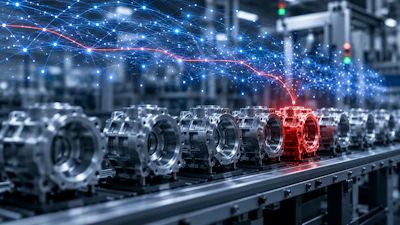
It’s worth noting that reasonable AI solutions don’t make existing IT investments void or replaceable. Rather, they layer on top of QMS or SPC infrastructure. In doing so, the AI maps complex process interactions and surfaces hidden drift before it turns into scrap.
 Instead of only looking backward at which products failed inspection, manufacturers should consider also asking what they can learn from everything that passed.Acerta AI
Learn From What Passed
Instead of only looking backward at which products failed inspection, manufacturers should consider also asking what they can learn from everything that passed. AI helps them do this by looking at both success and failure to chart the best course forward.
And by understanding the exact combinations of process variables that drive long-term reliability, teams can act before the field does. This translates to better products, faster time to market, with less wasted material and less wasted human time.
Pass/fail testing and compliance testing are not going away. They will always be foundational. But as manufacturing complexity accelerates, companies that can turn their data into immediate, decisive action will be a step ahead. AI unlocks their advantage.
Greta Cutulenco is the CEO and founder of Acerta AI.