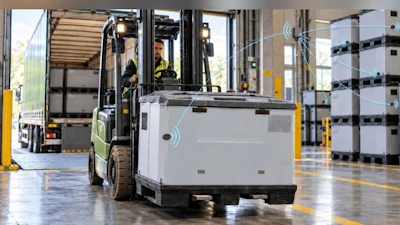
Thousands of load carriers move between plants, suppliers and logistics centers every day. Yet answering where the assets are exactly, how fast they return and whether existing inventories are sufficient often still requires significant coordination effort. A call to the supplier, an inventory check with the plant, another Excel spreadsheet: a great deal of effort goes into compiling the most up-to-date overview possible.
BLE-based tracking in the automotive industry simplifies this coordination effort and makes the networking of large fleets economically attractive. Organizations can start small. Even across just two or three locations, they can see what information the BOX ID system provides and which tasks it can take over in day-to-day operations. This experience forms the basis for further rollout - up to several hundred thousands of load carriers.
Watch your load carriers in motion during the pilot
Two company-owned locations, with load carriers circulating between them on a regular basis, are often enough for a pilot. Suppliers can be added as third locations. Selected load carriers are equipped, assigned in the BOX ID system and then continue through their normal operations.
With BLE-based tracking, compact beacons attached to the load carriers transmit signals. Static gateways detect these signals, for example within defined areas of a plant. Mobile gateways travel on selected load carriers and additionally collect and transmit the signals of nearby BLE-equipped load carriers. This approach creates additional detection points in transit and at partner locations without requiring fixed infrastructure at every site.
As the load carriers circulate, the BOX ID system collects data from the company’s own operations. Employees can see which units are detected at which locations, how long they remain there and when they return. The technology becomes immediately tangible because all involved roles can see their individual processes within the system.
First inventories, first deviations, first operational relief
During the pilot, the team can set up stocks and monitor inventory levels by location for the equipped load carriers. It is visible where enough load carriers are available and where a shortage may be developing. The team can also see when assets accumulate at one location while they are needed elsewhere. The first circulations already reveal deviations. A load carrier remains at a supplier longer than expected. A return is delayed. A location falls below its defined minimum stock. The teams involved can trace these situations and compare them with the information previously available from their daily operations.
Initial automations can also be configured in this stage. If a defined dwell time is exceeded or stocks fall below a minimum threshold, the system notifies the responsible employees. The software takes over continuous monitoring, allowing the team to focus on individual cases that require attention. This stages also makes the operational relief tangible. Which inventory checks are no longer necessary? How many search processes can be shortened? Where is less need to continuously reconcile lists manually? During the pilot, employees experience directly how the system changes their daily work.
What circulation data reveals about the entire fleet
With every additional circulation, it becomes clearer how fast the equipped load carriers move through the network. How much time passes between dispatch and return? How long do they remain at the supplier or at the company’s own plant? Where do actual circulation times differ from previous planning assumptions?
These insights help organizations assess fleet requirements more accurately. Long dwell times tie up load carriers that are unavailable for further transport operations. Once the root causes become visible, it is possible to assess more specifically whether faster returns or a different distribution of inventory could help avoid additional procurement.
A pilot therefore provides initial indications for the larger fleet. The extent to which the results can be transferred depends on how representative the selected cycles and observation period are. A regular transport to a known plant has different characteristics than a widely distributed supplier network. Even so, the next expansion stage gains a solid foundation: the company knows which information is useful, which automations provide value and where additional requirements exist.
Why is BLE-based tracking a cost effective solution for large fleets?
With BLE Hybrid Tracking, many load carriers share the infrastructure used for data transmission. Each carries a beacon, while only selected units require a mobile gateway with its own cellular connection. Static gateways complement this setup by detecting inventory at defined locations.
BLE-based tracking can significantly reduce tracking costs compared to equipping every load carrier with an independently transmitting cellular tracker
This advantage is particularly relevant when many load carriers travel together and the gateway infrastructure can be used efficiently. The distribution of the fleet, the required detection frequency and the amount of additional infrastructure all play an important role.
Within suitable coverage, additional beacons can be connected and existing gateways can serve more assets. Infrastructure costs are therefore distributed across a larger number of load carriers. Broad fleet coverage becomes economically viable, creating a much more complete view of inventories.
Once several plants and suppliers are connected, local shortages can be viewed in the context of the entire fleet. Available load carriers at another location become visible, circulation times can be compared and returns can be planned more effectively. The economic value therefore extends beyond savings in tracking technology alone.
A reliable rollout starts with accurate assignment
During a pilot, individual devices can still be managed manually. With tens of thousands of load carriers, every step needs to work reliably. Installation must be efficient, assignment must be unambiguous and the equipped units must then appear correctly in the system.
Rollout expertise includes the accurate pairing of trackers with the customer’s load carriers
This assignment connects the physical object with its digital record. Errors continue to affect inventory views and analyses later in the process. A clearly defined data capture process and verification of the assignment should therefore be part of deployment planning from the start.
The organization of the installation process is equally important. Where are the load carriers accessible? Which mounting position is suitable for each design? Can regular return flows be used, or is installation at the manufacturer a better option? Preconfigured devices, simple workflows and trained employees help integrate larger volumes into ongoing operations. The approach tested during the pilot is converted into a repeatable process. Additional locations can then build on it without having to redesign installation, assignment and commissioning each time.
Automotive experience makes scaling predictable
Automotive networks connect plants, suppliers and logistics service providers across company and national borders. Different types of load carriers, changing transport groups and high availability requirements shape day-to-day operations. Load carriers shipped together do not necessarily return together. Some remain longer at the supplier, while others move into a different circulation.
BOX ID specializes in automotive applications
Operating at this scale requires a coordinated approach across technology, deployment and operational use. During the rollout phase, the insights gained from the pilot are assessed for transfer to additional circulation routes, while the gateway distribution is adapted where necessary. Independently transmitting cellular trackers can be appropriate for individual load carriers that are widely dispersed. Their data also flows into the BOX ID system.
The rollout can proceed in successive phases: first, additional load carriers within the existing circulation, followed by further suppliers or plants. Proven installation processes, inventory rules and automations can be reused and adapted to the respective conditions.
With every expansion stage, the shared data foundation grows. More stocks become visible, deviations are identified earlier and the system takes over additional manual monitoring tasks. What begins between two or three locations, gradually develops into a tool for the entire load carrier network, supported by an economically scalable tracking architecture and proven processes for operating large automotive fleets.