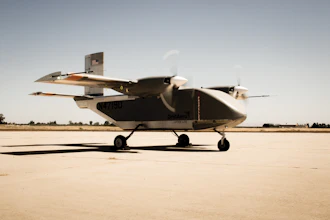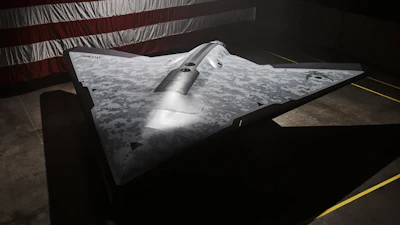
Shield AI has unveiled the first full-scale prototype for X-BAT, which it called the world’s first autonomous vertical take off and launch (VTOL) strike fighter.
Over the past year, the company said X-BAT has undergone wind tunnel testing, engine testing and thermal testing to address major technical risks. Now, the aircraft is now on its way from the company's development facility in Frisco, Texas, to its flight test facility in Newton, Kansas.
X-BAT is designed to be big enough to be able to carry strike weapons internally and externally, while maintaining the ability to execute air-to-air, electronic warfare and other mission sets. Shield AI said an F110 engine with thrust vectoring gives X-BAT a much more fighter-like flight envelope than smaller aircraft with Williams-type engines.
"Equally important to X-BAT’s capabilities is where it can actually operate and execute. We’re bringing multi-mission capabilities together in an aircraft designed to take off and land vertically, giving commanders more places to operate from and makes the aircraft harder to find and destroy. That optionality makes X-BAT an asymmetric threat," the company said.
Now Shield AI is set on proving out the vertical takeoff and landing technology that enables asymmetric operational options. The test campaign will start with the vehicle horizontal, sitting on the launch and recovery vehicle, running the engine. Then it will bring it up vertical and run the engine and the vehicle vertically.
Next, Shield AI said it will suspend the aircraft from a crane for testing before moving to untethered flights.
"The crane is only for testing. It exists purely as a safety mechanism to hang the vehicle from, so if we have an engine stall or other issue, we don’t crash the vehicle," the company said. "What we’re doing right now is focused on launch and recovery and making the envelope for that as wide as possible. Then we are aiming to fly the missionized aircraft in 2028 and ultimately get into production in 2029."
In Des Moines, Shield AI said it has signed its lease and is building the site out now. Hiring for the program has shifted to the region and is underway. Des Moines is the company’s first Puget Sound site, and Shield AI expects its footprint in the region to grow as production rates climb. King County has more than 45,000 aerospace workers at more than 400 companies, and Washington’s supplier base runs past 1,500 firms. Shield AI evaluated several regions and chose Washington for that workforce.