Putting a robot on a production line used to mean a six-figure budget, a caged work cell and a team of specialists. Collaborative robots, or cobots, changed that. Now, a six-axis cobot can be bought for a fraction of a traditional robot cell, deployed alongside people without fencing and re-tasked by an operator instead of a systems integrator.
This affordability has changed what makes robot selection difficult. When half a dozen robotic arms can all handle the same pick-and-place or machine-tending job, the selection process is no longer a matter of technical capability; it’s a matter of which robot best fits the part, cycle time and budget across its full service life.
The marketplace model — which connects users and suppliers of low-cost robotic components — answers that question. To get the most out of this platform, it’s important to first define the application, weigh total cost of ownership and account for any trade-offs between.
Step One: Start With the Application
Most automation projects begin by defining three key requirements:
Duty cycle. How hard, how often and for how long will the robot run? A robotic arm designed to perform a few picks per minute on a single shift is a different machine from one expected to run continuously across three. Duty cycle drives joint temperature, gear wear and service life, and under-specifying it is a common yet costly selection error.
Load carrying. In addition to the mass of the part, payload must consider end-of-arm tooling. A rated payload at the wrist flange is not the same as usable payload at full reach with an offset gripper, so tooling must be budgeted into the number.
Precision. Repeatability requirements vary across applications. A palletizing cell is forgiving, while inspection is not. The tightest requirements often rule out the cheapest arms first.
Once you define these three parameters, the economic questions come into play.
Step Two: Calculate Total Cost of Ownership
A cobot’s purchase price is a fraction of its lifetime cost, which includes acquiring, integrating, operating, maintaining and redeploying the system over its service life. The biggest cost differences are rarely in the arm itself:
- Integration and engineering, including cell design, risk assessment, safety validation, fixturing and installation. This is often the most substantial cost.
- Programming and commissioning, such as the labor to teach, tune and validate the job. A no-code workflow and text-based SDK deployment are very different bills.
- Software licensing. Many platforms ship their control software free, with no recurring fees.
- Maintenance and serviceability, such as routine maintenance, spare parts and if repairs can be done in the field. A design that lets you replace one worn joint in the field is less expensive to keep running than one that requires a complete return.
- Downtime, including the expected cost of an outage and how fast support and a local integrator can respond.
- Residual and redeployment value. A light, portable arm can be moved to a new station or reused for another task, recovering value in a way a fixed, heavy installation cannot.
The robotic marketplace model and expert consultation add value by making these costs visible and testable before you commit any capital.
Step Three: Match the Robot to Your Priority
There is no universally best cobot, but there is a best fit for a given application and a defined cost envelope. Each of the platforms, all available through the marketplace, wins for a different reason, whether you want the lowest price, a domestic supplier, the deepest ecosystem or the easiest programming.
Universal Robots (UR). UR pioneered the fenceless cobot and still has the longest track record and the largest installed base in the class. Its lineup spans roughly 3 kg to 30 kg of payload with a single, approachable programming experience: a touchscreen pendant running the PolyScope environment.
UR’s advantage lies in its UR+ ecosystem, which includes a deep catalog of certified accessories, a large pool of trained programmers and documented deployments in nearly every sector. You pay more up front in exchange for lower integration risk and long-term supportability.
Fairino. Fairino's FR series delivers competitive specs at a fraction of incumbent pricing. For example, a lower-cost FR5 against a UR5e several times its price comes down to a budget decision when both robots can do the task. The family runs from the compact FR3 (3 kg, 622 mm) up to the FR30 (30 kg), programmed through a browser-based, low-code web app with SDKs for C++, C#, Python and ROS.
Programming is not as turnkey as other platforms, so budget more commissioning effort beyond straightforward pick-and-place. The North American ecosystem is also young, which can drive support and downtime costs. Choose Fairino when the application is well-defined and unlikely to change, and the capital saved on the arm is better spent on tooling, cell design and training.
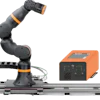
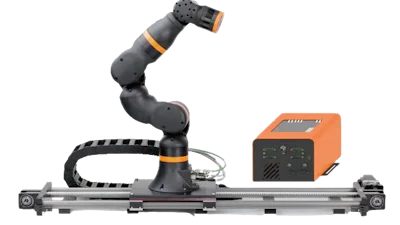
 The igus ReBeL is an all-polymer six-axis cobot. At roughly 8 kg, it is among the lightest arms in its class.igus
igus ReBeL. The ReBeL is igus’s all-polymer cobot and one of the lightest arms with a cobot function in its class, at around 8 kg. At its core is an industrial-grade plastic strain-wave gearbox developed in-house. The six-axis version handles a 2 kg payload with a 664 mm reach. It also ships with free igus Robot Control software that can be programmed even without the robot present, and integrates its controller into the base — no cabinet required.
The four-axis ReBeL carries a higher payload than the six-axis due to the shorter kinematic chain, so selecting on axis count alone can be misleading. Its serviceability is a cost advantage: joints replace individually, and the low mass makes the arm easy to redeploy. The trade-offs are precision — ±1 mm rules it out of high-precision insertion — and a modest payload budget. Choose the ReBeL when the task tolerates a millimeter and when weight and portability matter.
Standard Bots. Standard Bots’ 6-axis cobot is designed and assembled in the U.S. and delivers strong specifications for its price: 18 kg payload, 1,300 mm reach, ±0.025 mm repeatability and up to 3 m/s linear speed, with a no-code touchscreen interface and a teach-by-demonstration workflow built for fast, operator-run deployment.
Domestic manufacture can shorten lead times, simplify logistics and time-zone alignment, and reduce import exposure, which are all legitimate cost-and-risk factors. Choose Standard Bots when country of origin matters, or when you need higher payload and tight repeatability at a moderate price.
Match the Job at Lowest Total Cost of Ownership
The best collaborative robot is the one whose duty cycle, payload and precision match the job at the lowest total cost of ownership over its service life. State the application, model the whole cost rather than just sticker price and then weigh the trade-offs that matter to your operation.