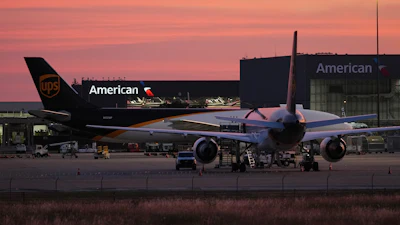
WASHINGTON (AP) — The Trump administration said Friday that new technology being added to the nation’s air traffic control system overloaded antiquated parts of it and caused “intermittent” communications and radar gaps, leading to the longest nationwide ground stop in 25 years.
It was lifted in the evening after a five-hour stretch when most flights were not allowed to take off from airports in the U.S.
Thousands of flights and potentially over a million travelers were affected. Secretary of Homeland Security Markwayne Mullin told reporters at the White House that no one was in any danger as more than 3,000 flights were safely landed. But Secretary of Transportation Sean Duffy said he could not guarantee it wouldn’t happen again.
The nationwide ground stop was the first since January 2023, when another key FAA computer system that sends notices to pilots malfunctioned, and the second since the aftermath of the Sept. 11, 2001, attacks.
During appearances on Sunday morning talk shows, Transportation Secretary Sean Duffy detailed what is known — and still unclear — about the problems that led up to his decision Friday to ground the planes, as he also pushed Congress for billions more to upgrade a system he said had been neglected for decades.
Duffy details what happened
In posts on X, Duffy said the problem began when federal contractor L3Harris was replacing a section of old copper wire with new fiber wire, causing the system to overload.
After the wire was replaced at the site in El Dorado, Arkansas, and the router was turned on, a problem then cropped up at a facility in Amarillo, Texas, cascading into the ground stop.
Duffy added that the problems were not linked to the FAA’s new AI-powered system the agency is rolling out to help predict problems in the sky because that isn’t connected to what failed on Friday.
The FAA said in a statement that "excessive data" was flooding the system "at a rate of 1,000 connection attempts every 4 to 5 seconds." That deluge created instability with "aircraft communications and radar feeds," the agency said. The contractor blocked the two locations in Arkansas and Texas, and the agency said that stabilized the network.
Duffy said billions are needed to build a "brand new architecture" for the network and said companies — including AT&T, Verizon and Lumen — are ready to deploy it "tomorrow" if the money is there. The FAA has already replaced thousands of old copper wires with fiber optic lines and upgraded hundreds of radio systems as part of the overhaul that began last year after Congress approved $12.5 billion of funding. Duffy and the White House are pushing for $30 billion more to complete the work.
Past problems have also been linked to equipment failures
The problem appeared similar to a regional air traffic control communication outage in September that snarled hundreds of flights across the Northeast, although that disruption was linked to a construction crew cutting a fiber optic line. Aging equipment was also blamed for the brief radar outages last year that disrupted Newark airport.
Aviation safety expert Steve Arroyo said the difference this time is that it happened on a nationwide scale that left controllers unable to reliably talk to pilots.
“If you don’t have that ability, whether it’s because the old wires that they have are just run down or for whatever reason, you’ve got to stop airplanes on the ground and not put them in the air, where you’re going to risk not being able to communicate with them,” said Arroyo, a former United Airlines pilot.
Aging air traffic control system has been a problem for years
The need to upgrade the nation's air transportation system is an effort that Congress has dedicated significant sums to in recent years.
Under President Joe Biden, Congress approved a massive infrastructure bill that included $25 billion over five years for airport and air traffic control infrastructure improvements. Much of that money went to airports for such things as new runways and taxiways, and new and refurbished terminals.
Under Trump, a Republican-led Congress approved $12.5 billion in 2025 to modernize the FAA's air traffic system.
The administration said the money would provide critical updates to outdated radar systems and traffic control centers, some dating back to the 1960s. Republicans used the same bill to allocate $170 billion for Trump's immigration crackdown, for more border security and immigration enforcement.
In a hearing on Sept. 15, FAA Administrator Bryan Bedford said with the money Congress provided, "we are executing on the most ambitious modernization and delivering it in record time."
The FAA upgrade has two phases. The first, funded by the $12.5 billion, is supposed to be completed by December 2028. A second phase involves developing new systems to track aircraft and optimize traffic. Bedford told lawmakers in September that the second phase will cost at least an additional $10 billion.
Separately, Sen. Eric Schmitt, a Missouri Republican, in September introduced a bill that builds on the $12.5 billion Congress approved last year and calls for about $30 billion more in new investments in the nation's air transportation system.
Schmitt's bill would include the $10 billion Bedford said is needed for the second phase. On top of that it includes money to modernize up to three medium hub airports and to make various airport improvements around the country, from new air traffic control towers to new terminals.
Then, on Friday, Duffy said he wants $50 billion, but he hasn't detailed what it's for. He said Saturday that he'll be sending a detailed request to legislators on Monday.
Democrats question rising costs and why money hasn't been spent
Congressional Democrats say they also want to upgrade the country's aging air traffic control system. But they are questioning the price tag.
Democrats on the House Transportation Committee said most of the money appropriated last year remains unspent.
"Explain to Congress, again, why they need more money?" Rep. Rick Larsen, the ranking Democrat on the committee, and Rep. André Carson, the top Democrat on a subcommittee with jurisdiction over aviation issues, said in a statement.
Democrats on the House Appropriations Committee are asking the same question. Rep. Rosa DeLauro, the top Democrat on the panel, said Congress has shown it's willing to invest in modernizing the FAA.
"But we need a competent partner at the Department of Transportation to carry this out in a sustainable, transparent manner. Right now, it is clear that we lack such a partner," DeLauro said.
Duffy said Sunday the money appropriated last year by Congress will be spent by the end of 2028. He also said his agency was restricted by Congress in how it could be spent and that didn't include spending on the FAA's telecommunications infrastructure.
Travel should return to normal by Monday
As for the traveling public, Duffy said that "as we look to the end of the day and into tomorrow, we should be running at full capacity."
Duffy said the administration feels "pretty good" that the breakdown did not result from a hacking event. He said various intelligence agencies have said they were not finding the "chatter or the footprints that we would normally see if this was a cyberattack."
Duffy appeared on CBS' "Face the Nation," CNN's "State of the Union," "Fox News Sunday," NBC's "Meet the Press" and ABC's "This Week."