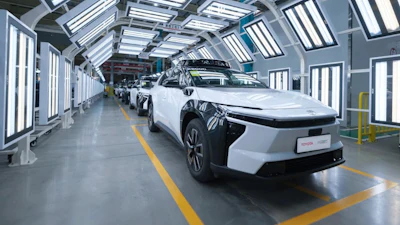
Pony.ai, a company specializing in large-scale production and commercialization of autonomous driving technology, said that the first mass-produced bZ4X Robotaxi, developed in collaboration with Toyota, has officially rolled off the production line.
The companies plan to produce more than 1,000 bZ4X Robotaxis in 2026, with vehicles to be gradually introduced into commercial services across China's Tier 1 cities. This effort supports Pony.ai's goal of expanding its total Robotaxi fleet to more than 3,000 vehicles by the end of this year.
The bZ4X Robotaxi is jointly developed by Pony.ai, Toyota Motor China, and GAC Toyota. Production is carried out collaboratively by Pony.ai and GAC Toyota, one of Toyota's global model plants.
The vehicle is equipped with Pony.ai's latest seventh-generation (Gen-7) autonomous driving system. Its core components are 100% automotive-grade, and the bill of materials (BOM) cost of the autonomous driving kit has been reduced by 70% compared with the previous generation. Pony.ai unveiled its Gen-7 Robotaxi lineup, comprising three models including the bZ4X, in April last year. The other two models entered commercial service in November.
The Gen-7 Robotaxis include features like Bluetooth-based automatic vehicle unlocking, in-cabin voice interaction, online music services, and pre-trip climate control, alongside refined acceleration and braking patterns to help minimize motion sickness.
To meet the safety and reliability requirements of Robotaxi operations, the bZ4X Robotaxi production line deeply integrates the Toyota Production System (TPS), with dedicated systems for production management, quality control, and safety management. Toyota's core principles of Quality, Durability, and Reliability (QDR) are embedded throughout the entire Robotaxi production process, establishing a strong foundation for quality and safety in future large-scale operations.