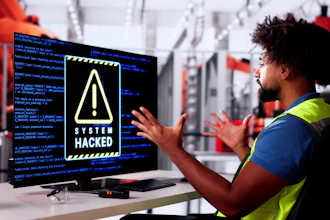
Ask most plant or field leaders why a ransomware crew would target them, and you tend to get the same shrug. We pour concrete. We make parts. Nobody wants our data.
The Gentlemen built a business on proving that shrug wrong, surfacing in mid-2025 and scaling fast on a double-extortion model that pairs file encryption with stolen data and a public leak site. Manufacturing and construction sit near the top of its target list, alongside healthcare and insurance, and the "we have nothing worth stealing" line falls apart the moment you check who lands on that site.
Boring is the Wrong Word
Pull up who actually lands on those leak sites and the picture sharpens fast. Ransomware now figures in 44 percent of all breaches, and manufacturing absorbs the biggest share of any industry, a position it has held for several years running. Construction sits in the same tier, pulled there by the same operational pressure that makes the sector pay.
These sectors pay because downtime is brutally expensive, and the loss runs by the hour for any stopped line or stalled project. Unplanned downtime in manufacturing averages close to $260,000 an hour, and that figure climbs fast in automotive and other high-volume plants. Attackers read that clock better than most operators do, and they price the ransom against it.
A sector that cannot tolerate idle equipment is a sector more likely to pay to get operational technology back online. The same pressure runs through construction, where a frozen project office stalls schedules tied to penalty clauses, bonded deadlines and impatient general contractors. That willingness is the whole pitch.
The double-extortion model turns the screw twice, freezing the floor with encryption while the leak site goes to work on the data everyone assumed was worthless. Project bids, signed contracts, employee records, client files. The value to you is beside the point. That information only has to embarrass you or hand a competitor an edge to do its job.
Inside the Playbook
The Gentlemen earn a closer look for how they move once inside a network. The crew leans on the same tools your administrators use every day, which is exactly what makes the intrusion hard to spot.
The group abuses Group Policy, the system IT relies on to manage every machine in a domain, to push its ransomware across the whole environment in one motion. One foothold becomes organization-wide reach. Along the way it switches off Microsoft Defender's real-time protection, adds folders to the exclusion list so its payload runs unwatched, then deletes the Volume Shadow Copies Windows keeps for recovery.
By the time encryption starts, the safety net is already gone.
None of those steps looks like the malware people picture, since much of it rides on legitimate Windows functions and native commands that slip past controls trained to watch for obvious threats. The group also runs a ransomware-as-a-service model, so a rotating set of affiliates carries the same playbook from one target to the next.
For operators, that reliance on trusted tools should reshape what counts as coverage, because a defense that only waits for a flagged file will miss an attacker moving through Group Policy and native system commands. A floor supervisor will not see anything unusual until the screens lock and the ransom note loads.
Close the Gaps Before They Do
The harder question for any plant or field leader is whether those defenses actually stop this behavior or only seem to. Most teams carry a stack of tools and a strong feeling that things are covered, and The Gentlemen's affiliates are happy to check that assumption on their own schedule.
Real defense starts with testing your protection against this group's behavior rather than trusting the brochure. That looks like safely running the same techniques the crew uses against your own systems and watching whether your controls catch them or let them slide. You find the holes on a quiet afternoon instead of during an outage, which is the cheapest version of this lesson you will ever get.
Your ability to recover deserves equal weight, because recovery strips the attacker of leverage. Keep clean backups offline and away from the production network and restore them on a schedule, so you know they work. An operator who can bring a line back without negotiating has knocked out half the attack, and the leak site loses its sting when an outage runs hours instead of days.
Containment earns its place because this group turns one stolen administrator login into control of an entire plant. Keep that first foothold small with multifactor authentication on privileged accounts and a firm boundary between the business network and the plant floor, so an intrusion that starts in an inbox never reaches the machines that run production.
Don't Prove Them Right
The plants that get burned are rarely the ones sitting on the most valuable data. They are the ones that believed they had none.
The Gentlemen are betting that "boring" industries keep underinvesting because they cannot picture themselves as a target, and every unanswered intrusion makes that bet pay off. Run the playbook against your own controls and find the gaps on a quiet afternoon instead of during an outage, then prove the bet wrong before someone collects on it.