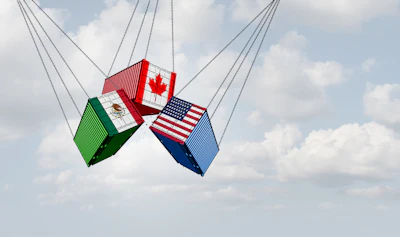
By choosing not to renew the United States-Mexico-Canada Agreement on July 1, despite Canada and Mexico wanting to extend it, the Trump Administration set a number on interesting wheels in motion. Although the agreement remains in place, by not agreeing to extend it at this time for another 16 years, the USMCA will now be subject to annual renewals through 2036.
While talks continue with the goal of realizing a better deal for the U.S., the actions, or inactions, depending on your perspective, have fueled some uncertainties. A number of industry stakeholders reached out to Industrial Media to share some optimistic outlooks, concerns and projections.
Drew DeLong, Head of Corporate Statecraft at Kearney Foresight.
"USMCA is critical to several key supply chains that the U.S. deems a national security priority. Therefore ending USMCA would mean eliminating those supply chains. The U.S. and Mexico have already concluded two rounds of negotiations on a bilateral basis, while Canada has shifted their negotiating posture to be open to partner more with the U.S.
"My current expectation is that we will see two separate bilateral deals 'stack' on top of the existing USMCA framework. The trilateral foundation underneath may remain in an annual review cycle, or we may get lucky and post-bilateral deals, they could all agree on the set foundation, and extend… but that’s a wild card.
"The latest results of the negotiations with Mexico show a mixed view of key negotiating priorities. The U.S. wants American content thresholds for auto supply chains: the big wild card here is whether this standard is set first for auto and will then be used on other key industries.
"Mexico wants Section 232 relief for metals (e.g., steel & aluminum), but the pushback has been that Mexico would need to adopt their own 'mirror' tariffs if that happens—for example, the U.S. lowers tariffs down to 15-25 percent, but Mexico raises their own metals tariff up to 15-25 percent to avoid circumvention. The U.S. is also pushing a disqualifier for duty-free treatment based on content from certain countries—that list of countries has yet to be determined.
"My expectation: USMCA will stay, but rules of the game are set to change dramatically. News headlines will gravitate toward 'Trump wants out of USMCA, but I think a push toward a reconfigured 'North American Fortress' approach is the more likely direction.
"Canada’s Premier Ford socialized Canada’s vision for the USMCA negotiations and titled their position the same 'North American Fortress' strategy. As an example, for companies not running the scenario modeling on how rules of origin/USMCA changes may impact their (1) product design, (2) BOM configuration, and (3) network strategy through North America, that window is closing rapidly."
Melissa Irmen, Director of Advocacy, National Association of Foreign Trade Zones (NAFTZ)
"The good news is that the current rules of the agreement don't change immediately. With the deadline passing without a renewal or extension, USMCA moves into a sunset framework that keeps the existing agreement in place for up to 10 years, unless otherwise announced.
"So for now, cross-border commerce continues to operate under the same terms companies have planned around. What does change is the level of uncertainty. Annual reviews are now triggered under this framework, and those will likely build renewal pressure over time. For distributors and manufacturers moving goods across the U.S., Mexico and Canada, that means the operating rules are stable in the near term, but the political backdrop they're planning against is less predictable than it was a year ago.
"It doesn't appear that USTR (U.S. Trade Representative Jamieson Greer) is moving toward a near-term renewal or a new full-term extension. The read heading into this deadline was that the administration was letting the clock run out rather than pushing toward a formal commitment.
"That said, continued conversations with Mexico this month matter because they'll shape whether the annual review process starts building toward renewal or toward more contentious territory. It is also worth remembering that any of the three countries could announce a withdrawal at any point under the agreement (that's a standing possibility built into USMCA, not something specific to this deadline), but a full withdrawal by any of the three remains unlikely since there is little to no negotiating leverage gained by walking away entirely.
"For operators, the near-term picture is one of continuity because the current rules remain in force for up to a decade. That gives companies a runway to keep executing on sourcing and distribution strategies across North America.
"But uncertainty has a cost even when the rules haven't changed yet: multi-year investment decisions, capital commitments in manufacturing or distribution infrastructure, and pricing strategy are more difficult to plan confidently when there is a recurring annual review process introducing fresh political risk each year.
"This is exactly why legislation like Senator Tim Scott's bill (and its House companion) is pertinent regardless of how the broader renewal question plays out. It would amend USMCA to provide parity for U.S. exporters operating out of U.S. Foreign-Trade Zones shipping to Mexico and Canada.
"Right now, there's no structured duty relief program in the U.S. for this, even though Mexico and Canada already have comparable initiatives in place. For U.S. FTZ manufacturers and distributors trying to stay competitive regionally, closing that gap is a tangible, near-term fix that doesn't depend on how USMCA's larger renewal timeline plays out."
Tosca Derrick, Director with Baker Tilly’s Global Trade Management Services
"The industries with the greatest exposure are those that have built highly integrated North American supply chains and rely heavily on USMCA preferential treatment. The automotive sector is likely to remain a primary focus given the agreement's existing regional value content, labor value content, steel, and aluminum requirements.
"Other sectors that could face increased scrutiny include industrial equipment, machinery, batteries, semiconductors, medical devices, energy products, and advanced manufacturing.
"Companies that depend on inputs sourced outside North America may face heightened risk if future negotiations lead to stricter regional sourcing requirements or changes to the rules of origin. More broadly, businesses that rely on cross-border manufacturing, regional value content calculations, or USMCA qualification analyses should closely monitor the review process, as these areas are frequently discussed as potential subjects for future negotiation.
"Although no immediate changes are required, companies should use this period to evaluate their exposure to potential modifications in the agreement. First, businesses should review current USMCA claims, supplier certifications, and supporting documentation to ensure they can substantiate origin determinations and compliance positions.
"Second, companies should map critical supply chains and understand where key materials and components originate, especially where non-North American inputs are involved. Third, organizations should assess how potential changes to regional value content thresholds, sourcing requirements, or rules of origin could affect costs, sourcing strategies, and qualification for preferential treatment.
"Finally, companies should establish a process for monitoring developments and coordinating among trade, procurement, supply chain, tax, and finance functions so they can respond efficiently if changes are ultimately negotiated."
Juliet Abdel, President & CEO, Cedar Rapids (Iowa) Metro Economic Alliance
"Canada and Mexico aren't just Iowa's largest trading partners, they're essential to the integrated North American economy that powers our state's manufacturing, agriculture and food processing sectors. Together, they account for more than $8.6 billion in Iowa exports, supporting businesses and jobs across our communities.
"As one of the nation's leading agricultural producers and a growing advanced manufacturing hub, Iowa depends on a modern, predictable USMCA framework that gives businesses the confidence to invest, innovate and compete across borders."