Manufacturers have spent years improving their ability to manage changing demand. Forecasting has become more sophisticated, planning cycles have accelerated, and organizations have invested heavily in visibility and analytics to better understand shifting customer behavior and market conditions.
Yet, the disruptions creating the greatest pressure today often originate somewhere else entirely.
While demand fluctuations remain a challenge, many manufacturers have developed the processes and technologies needed to respond with greater speed and confidence. Supplier instability, trade policy shifts, shipping disruptions, geopolitical tensions, and raw material shortages continue to disrupt manufacturing operations around the world.
Many manufacturers have realized that upstream disruption is much different from demand-side variability and considerably harder to absorb. A recent study found that 57 percent of manufacturers identified raw materials and components as the most disrupted area of their supply chain, ahead of demand fluctuations at 40 percent.
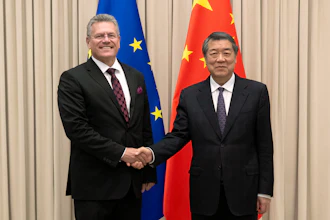
The same study found 86 percent of manufacturers reported a material impact from trade policy. Upstream pressure is now the most common source of disruption manufacturers report. As a result, manufacturers are reassessing long-standing assumptions about resilience and looking for new ways to prepare for uncertainty before it affects production, service levels and profitability.
Why Upstream Disruption is Harder to Absorb
Demand uncertainty and supply disruption are often grouped together under the broader category of supply chain risk, but they behave very differently in practice. When customer demand changes, manufacturers usually have signals to work with. Sales data, customer orders, promotions, and forecasts provide early indicators that conditions are shifting. These signals are not perfect, but they create opportunities to adjust plans before the full impact is felt.
Upstream disruption rarely provides the same warning. A supplier shutdown, transportation disruption, export restriction, or geopolitical event can quickly affect material availability with little notice. In many cases, manufacturers discover the issue only after lead times begin extending, or deliveries fail to arrive as expected.
Several factors make upstream disruption particularly challenging. Longer lead times reduce the number of available response options, critical materials often have limited substitutes, and highly interconnected supplier networks allow disruption in one region to ripple through multiple tiers of the supply chain. Many of the underlying causes are also outside a manufacturer’s direct control, influenced by policy decisions, international events, infrastructure constraints, and environmental factors rather than operational execution.
Unlike demand uncertainty, which can often be mitigated through better forecasting, upstream disruption requires organizations to prepare for events that may be difficult to predict altogether, especially when longer lead times leave fewer response options available.
The Resilience Playbook is Changing
For decades, resilience was largely built through redundancy. Manufacturers carried additional safety stock, expanded supplier networks, and maintained operational buffers to protect against uncertainty. These strategies remain useful, but they are becoming harder to justify at scale.
The shift is already visible. Manufacturers reporting extra safety stock fell from 43 percent to 28 percent year over year, and supplier diversification declined from 50 percent to 37 percent. Over the same period, collaboration with logistics partners rose from 52 percent to 59 percent. Manufacturers are trading buffer size for partnership depth.
As disruption becomes more persistent and supply chains become more complex, many manufacturers are moving beyond resilience strategies built primarily on scale. Instead, they are investing in deeper supplier collaboration.
Closer relationships with key suppliers create opportunities for shared forecasting, joint planning, and earlier visibility into potential constraints. Rather than relying on a larger number of suppliers, many organizations are focusing on stronger coordination with the suppliers that matter most.
The same shift is taking place in inventory management. Rather than broadly increasing inventory levels across the network, manufacturers are becoming more deliberate about where inventory is positioned, which materials require additional protection, and how safety stock policies should adapt as conditions change. Resilience is becoming less about how much buffer an organization can afford and more about how intelligently it can deploy available resources.
Planning for Disruption Before it Happens
AI has already become an important tool for improving forecasting, inventory management, and production planning. Manufacturers are already moving in this direction. The same study found 67 percent reporting rising confidence in AI for supply chain decisions and 71 percent planning generative AI investment over the next year. These applications help organizations optimize existing operations and make better day-to-day decisions.
But optimization, by definition, works within the parameters of current conditions. It improves execution but does not prepare organizations for the moment those parameters change. Manufacturers are beginning to look beyond supply chain efficiency alone and focus on how their operations would respond when conditions change.
hey are now thinking about how their operations would respond if a critical supplier went dark, a major shipping route became unavailable, or a change to tariffs restructured landed cost assumptions overnight.
Scenario planning addresses this gap. Rather than waiting for disruptions to arrive, they can evaluate potential disruptions before they occur so that they can better understand vulnerabilities, compare response options, and identify the tradeoffs associated with different decisions. Instead of reacting once disruption arrives, manufacturers can establish contingency plans in advance.
For example, a manufacturer facing concentration risk in a single-source critical component can model the impact of a supply failure and evaluate dual-sourcing strategies, inventory pre-builds, or design substitutions against each other before the disruption forces the question. No organization can predict every disruption with certainty because some degree of uncertainty will always remain.
However, those that have already worked through their response options can move faster when conditions do change. They can evaluate alternatives, adjust sourcing strategies, modify production plans, and communicate decisions with greater confidence, compressing the time between disruption and effective response.
Supply chain disruptions won’t disappear. Geopolitical uncertainty, changing trade relationships, transportation constraints, and evolving supplier networks continue to create challenges for manufacturers around the world. The manufacturers that perform best will understand potential risks sooner, evaluate alternatives faster, and adapt their plans before disruptions spread across operations.
Manufacturers cannot eliminate uncertainty, but they can shorten the gap between disruption and response. Scenario planning is the capability that closes it. The manufacturers that build it now will set the pace as upstream risk continues to reshape global supply chains.