VATICAN CITY (AP) — The Vatican is opening a celebration of the popemobile, the now-iconic vehicle that for nearly a century has let popes get close to the faithful at home and abroad.
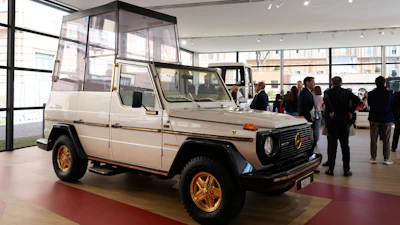
The Vatican Museums on Wednesday unveiled a preview of the exhibition commemorating "A Century of the Popemobile," featuring eight Mercedes-Benz versions of the car that popes have used since 1930. It officially opens to the public on Thursday.
Separately, Pope Leo XIV — a big car lover — met with top Mercedes-Benz executives and thanked them for their partnership with the Holy See. In his remarks, the Chicago-born pope noted that the advances in automotive technology had accompanied the advances and evolutions of papal travel.
 AP Photo/Isaia Montelione
"Over the decades, the popemobile has evolved from a means of transportation into an instrument of encounter, enabling the pontiff to draw closer to the faithful during pastoral visits and public celebrations," Leo said. "In this way, your work has helped facilitate the church's mission of reaching out to people and bringing a message of faith, of hope and of charity to the world."
The oldest car on display in the Vatican Museum exhibit was given to Pope Pius XI on May 23, 1930. The Mercedes-Benz Nürburg 460 featured a luxurious armchair upholstered in silk brocade and finishes of fine wood and metal.
It "was specifically built, designed, and prepared for papal use, so much so that just by comparing it, you can see how it transitions from the serial to the unique," said Sandro Barbagallo, curator of the Historical Collections Department at the Vatican Museums.
"From this point, it is clear how all the cars were then made, precisely to allow the pope to be seen, but to be seen and to see in total safety and, I would even say, comfort," he said.
Later versions of the popemobile on view reflected the changing needs of a pope on the road, most importantly his need to engage with the faithful and — more recently — bless babies that were brought to him.
 AP Photo/Isaia Montelione
In 1960, Pope John XXIII was presented with the 300 d Landaulet, with a detail that foreshadowed change: The removable rear side windows allowed the future saint to reach out to those he met along the way.
In 1980, for St. John Paul II's visit to Germany, Mercedes-Benz developed the 230 G, which featured another major innovation: a tall, transparent dome at the rear, providing safety but also guaranteeing a clear view for the millions of faithful gathered to see him.
In his remarks to the Mercedes-Benz executives, Leo recalled the electric popemobile they presented to Pope Francis in keeping with the Argentine pope's ecological priorities.
"In this spirit, I encourage you to continue placing technological innovation at the service of human dignity, care for creation and the common good," he said.