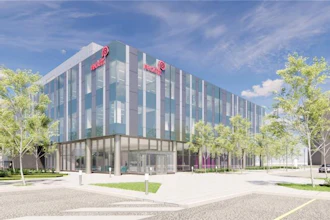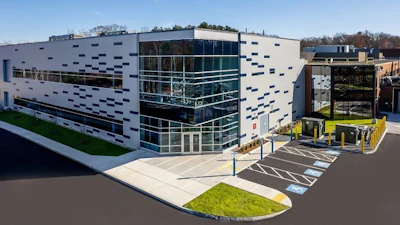
Andover, MA -- Last Friday, Vicor, a designer and manufacturer of modular power components and complete power systems, announced the acquisition of a 334,000-square-foot building on 66 acres of industrial land in Merrimack, New Hampshire and 54 acres in Hooksett, New Hampshire.
The two sites will support the build-out of Vicor ChiP Fab-2 and Fab-3 with a combined footprint of nearly one million square feet. Fab-2 and Fab-3 will expand total capacity beyond that of ChiP Fab-1, which was built out to 320,000 square feet on 16 acres in Andover, Massachusetts. Fab-1 utilization is approaching capacity.
With intellectual property for Vertical Power Delivery (VPD), Vicor has achieved the performance needed for advanced AI applications, which are limited by multi-phase voltage regulators (VRs) and integrated voltage regulators (IVRs).
By expanding total capacity, with a one-year lead time to initial deployment for ChiP Fab-2, the company hopes to provide the scalability needed to support OEMs and hyperscalers.
According to the company, the expansion will fill gaps in supply chains increasingly challenged by technical limitations and recurring disruptions from suppliers of infringing power systems.
"Leading OEMs and hyperscalers, whose computing systems were banned from importation because of infringing power suppliers, need Freedom to Operate (FTO) and U.S. sourcing," the company said in a statement. "Vicor’s licensing practice and future capacity from a multiplicity of ChiP fabs provide predictability and performance to the AI hardware ecosystem."
Yesterday, the company announced it granted a non-exclusive license to a new OEM licensee to procure VPD modules covered by Vicor patents. VPD enables high-performance AI compute and network processors to run at high current density from a low-voltage source. The systems enable breakthrough performance by avoiding the “last-inch problem” of lateral power delivery (LPD), according to the company, and are protected by foundational patents.
Vicor’s licensing practice provides OEMs and hyperscalers with multi-source flexibility, supply chain redundancy and scalability, including from U.S. based Vicor fabs.
According to the company, unlicensed OEMs and hyperscalers may need a license to secure their supply chain as high-performance compute and network processors migrate to VPD. Vicor noted that supply agreements with infringing suppliers may include indemnification provisions to recover royalties and monetary damages, but cannot override importation bans.
Licensing has become a significant revenue source for the company, and in October 2025, the company boosted its IP licensing practices, including an in-house licensing team and outside counsel.
Last year, the International Trade Commission issued a Limited Exclusion Order (LEO) banning the import of bus converters that infringed upon Vicor’s patents into the U.S. This included computing systems containing these converters. The LEO has led to settlements and licensing agreements, resulting in nearly $300 million in revenue for Vicor through 2026.
IEN reached out to Vicor, but the company did not immediately respond to our request for comment.